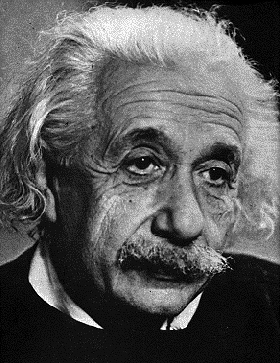
Einstein did not believe in a personal God, but neither did he support Atheism.
"In view of such harmony in the cosmos which I, with my limited human understanding, am able to recognize, there are yet people who say there is no God. But what really makes me angry is that they quote me for the support of such views." — Prince Hubertus zu Löwenstein,
Towards the Further Shore (Victor Gollancz, London, 1968), p. 156; quoted in
Jammer, p. 97
This article appears in Einstein's
Ideas and Opinions, pp.41 - 49. The first section is taken from an address at Princeton Theological Seminary, May 19, 1939. It was published in
Out of My Later Years, New York: Philosophical Library, 1950. The second section is from
Science, Philosophy and Religion, A Symposium,
published by the Conference on Science, Philosophy and Religion in
Their Relation to the Democratic Way of Life, Inc., New York, 1941.
http://www.einsteinandreligion.com/scienceandreligion.html
_________________________________________________________________________________
During the last century, and part of the one before, it
was widely held that there was an unreconcilable conflict between
knowledge and belief. The opinion prevailed among advanced minds that it
was time that belief should be replaced increasingly by knowledge;
belief that did not itself rest on knowledge was superstition, and as
such had to be opposed. According to this conception, the sole function
of education was to open the way to thinking and knowing, and the
school, as the outstanding organ for the people's education, must serve
that end exclusively.
One will probably find but rarely, if at all, the
rationalistic standpoint expressed in such crass form; for any sensible
man would see at once how one-sided is such a statement of the position.
But it is just as well to state a thesis starkly and nakedly, if one wants to clear up one's mind as to its nature.
It is true that convictions can best be supported with
experience and clear thinking. On this point one must agree unreservedly
with the extreme rationalist. The weak point of his conception is,
however, this, that those convictions which are necessary and
determinant for our conduct and judgments cannot be found solely along
this solid scientific way.
For the scientific method can teach us nothing else beyond
how facts are related to, and conditioned by, each other.The aspiration
toward such objective knowledge belongs to the highest of which man is
capabIe, and you will certainly not suspect me of wishing to belittle
the achievements and the heroic efforts of man in this sphere. Yet it is
equally clear that knowledge of what is does not open the door directly
to what should be.
One can have the clearest and most complete knowledge of what is, and
yet not be able to deduct from that what should be the goal of our
human aspirations. Objective knowledge provides us with powerful
instruments for the achievements of certain ends, but the ultimate goal
itself and the longing to reach it must come from another source. And it
is hardly necessary to argue for the view that our existence and our
activity acquire meaning only by the setting up of such a goal and of
corresponding values.
The knowledge of truth as such is wonderful, but it is so little
capable of acting as a guide that it cannot prove even the justification
and the value of the aspiration toward that very knowledge of truth.
Here we face, therefore, the limits of the purely rational conception of
our existence.
But it must not be assumed that intelligent thinking can
play no part in the formation of the goal and of ethical judgments. When
someone realizes that for the achievement of an end certain means would
be useful, the means itself becomes thereby an end. Intelligence makes
clear to us the interrelation of means and ends. But mere thinking
cannot give us a sense of the ultimate and fundamental ends.
To make clear these fundamental ends and valuations, and to set them
fast in the emotional life of the individual, seems to me precisely the
most important function which religion has to perform in the social life
of man. And if one asks whence derives the authority of such
fundamental ends, since they cannot be stated and justified merely by
reason, one can only answer: they exist in a healthy society as powerful
traditions, which act upon the conduct and aspirations and judgments of
the individuals; they are there, that is, as something living, without
its being necessary to find justification for their existence. They come
into being not through demonstration but through revelation, through
the medium of powerful personalities. One must not attempt to justify
them, but rather to sense their nature simply and clearly.
The highest principles for our aspirations and judgments
are given to us in the Jewish-Christian religious tradition. It is a
very high goal which, with our weak powers, we can reach only very
inadequately, but which gives a sure foundation to our aspirations and
valuations. If one were to take that goal out of its religious form and
look merely at its purely human side, one might state it perhaps thus:
free and responsible development of the individual, so that he may place
his powers freely and gladly in the service of all mankind.
There is no room in this for the divinization of a nation,
of a class, let alone of an individual. Are we not all children of one
father, as it is said in religious language? Indeed, even the
divinization of humanity, as an abstract totality, would not be in the
spirit of that ideal. It is only to the individual that a soul is given.
And the high destiny of the individual is to serve rather than to rule,
or to impose himself in any other way.
If one looks at the substance rather than at the form,
then one can take these words as expressing also the fundamental
democratic position. The true democrat can worship his nation as little
as can the man who is religious, in our sense of the term.
What, then, in all this, is the function of education
and of the school? They should help the young person to grow up in such a
spirit that these fundamental principles should be to him as the air
which he breathes.Teaching alone cannot do that.
If one holds these high principles clearly before one's
eyes, and compares them with the life and spirit of our times, then it
appears glaringly that civilized mankind finds itself at present in
grave danger, In the totalitarian states it is the rulers themselves who
strive actually to destroy that spirit of humanity. In less threatened
parts it is nationalism and intolerance, as well as the oppression of
the individuals by economic means, which threaten to choke these most
precious traditions.
A realization of how great is the danger is spreading,
however, among thinking people, and there is much search for means with
which to meet the danger--means in the field of national and
international politics, of legislation, or organization in general.
Such efforts are, no doubt, greatly needed. Yet the ancients knew
something- which we seem to have forgotten. All means prove but a blunt
instrument, if they have not behind them a living spirit. But if the
longing for the achievement of the goal is powerfully alive within us,
then shall we not lack the strength to find the means for reaching the
goal and for translating it into deeds.